Rewriting the Script – Recovery, Creativity and the Power of Film
Podcast: Play in new window | Download
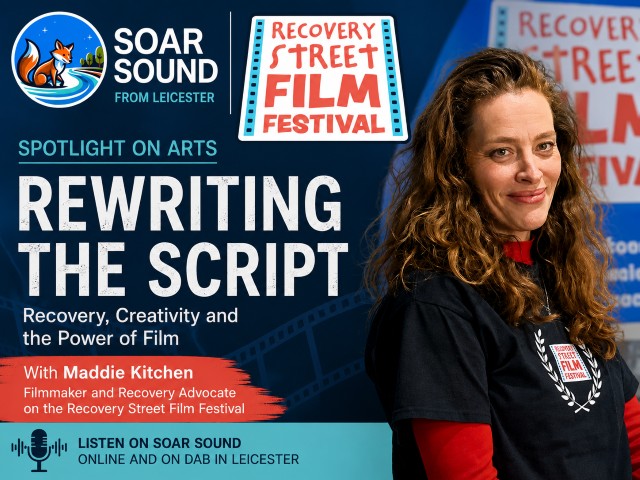
What happens when people affected by addiction are given the opportunity to tell their own stories, in their own way?
In this edition of Spotlight on Arts, Rob Watson talks with filmmaker and recovery advocate Maddie Kitchen about the Recovery Street Film Festival, a UK-wide festival dedicated to films made by and about people affected by substance use.
The festival invites people to make short films of between one and three minutes. This year’s theme, Rewriting the Script, asks filmmakers to reflect on their experiences of recovery and the changes that become possible when people begin to imagine a different future.
For Maddie, the important thing is not expensive equipment or professional filmmaking experience. A film can be made with a professional camera or with the phone somebody already carries in their pocket. What matters is the story.
That principle runs throughout the conversation.
 Maddie describes how the festival creates space for lived experience voices that are often missing from conventional media. Films might address difficult experiences associated with addiction, but the emphasis is not simply on suffering. They can also explore recovery, hope, relationships, creativity and the gradual process of rebuilding a life.
Maddie brings her own experience to this work. She trained in filmmaking, worked at ITN and later with the Media Trust, before establishing Sobriety Films in 2019. Her filmmaking practice now combines professional experience with her own long-term recovery from alcohol dependence.
She describes filmmaking as something that has remained fundamental to her throughout her life.
Creativity as Part of Recovery
The conversation moves beyond the film festival itself and considers what participation in creative activity can mean for somebody recovering from addiction, trauma or periods of serious difficulty.
Making a film can involve learning about cameras, sound, editing, writing, directing or producing. But the significance of the process may lie somewhere deeper. People work together, exchange experiences, and begin to discover forms of creativity that may previously have felt inaccessible.
As Maddie explains, the finished film is only one part of that process.
For somebody who has experienced addiction or who is beginning recovery, seeing something they have created projected onto a cinema screen can provide a powerful recognition that their experience matters and that they are capable of creating something other people value.
Finding a Voice
Rob and Maddie also discuss the relationship between creativity, feeling and personal identity.
The conversation draws briefly on Carl Jung’s idea of individuation: the process through which a person gradually develops a stronger understanding of themselves. Maddie sees a parallel with recovery, where people may need to rediscover an identity that is no longer organised around substances or previous experiences.
Filmmaking can help create the conditions for that exploration.
Maddie describes beginning workshops with apparently simple questions. What is your favourite film? What does creativity mean to you? What does recovery mean to you?
From those starting points, stories begin to emerge.
She recalls working with one woman who initially insisted that she could not make a film. Asked who she loved most in the world, she eventually began talking about her cat. That conversation opened into a much larger story about recovery, survival and poetry she had written years earlier.
The example illustrates one of the main ideas running through the programme: creative ability does not necessarily have to be taught before somebody can participate. Sometimes it has to be recognised.
The Recovery Street Film Festival Comes to Leicester
The Recovery Street Film Festival provides one setting where that can happen.
This year the festival comes to Leicester for the first time in the Midlands, working in partnership with Phoenix Cinema and with sponsorship from Leicester City Council.
The public screening takes place at Phoenix on 26 September between 2pm and 4pm. Audiences will be able to watch the selected films and take part in a question-and-answer session with filmmakers. An afterparty is also planned at the Stairway Project.
Film submissions remain open until 23 August.
The festival is particularly encouraging younger filmmakers to participate. A special prize has been introduced for people aged between 16 and 25, recognising that younger people affected by substance use may have experiences that are not always represented publicly.
Participation Matters
Ultimately, the discussion is about more than filmmaking.
It is about what can happen when people are trusted to speak for themselves, when technical barriers are reduced, and when creative participation becomes something ordinary people can undertake rather than something reserved for professionals.
For community media, that distinction matters.
The value of making something together cannot always be measured simply by the quality of the finished production. It can also be found in the confidence developed, relationships formed and stories discovered along the way.
Listen to this edition of Spotlight on Arts to hear Maddie Kitchen discuss the Recovery Street Film Festival, her own experience of recovery and filmmaking, and why creativity can provide a powerful way for people to begin rewriting their own scripts.