Creativity Under the Arches – Art, Craft and Community at Braunstone Gate
Podcast: Play in new window | Download
What can happen when an overlooked urban space is placed in the hands of people prepared to imagine something different?
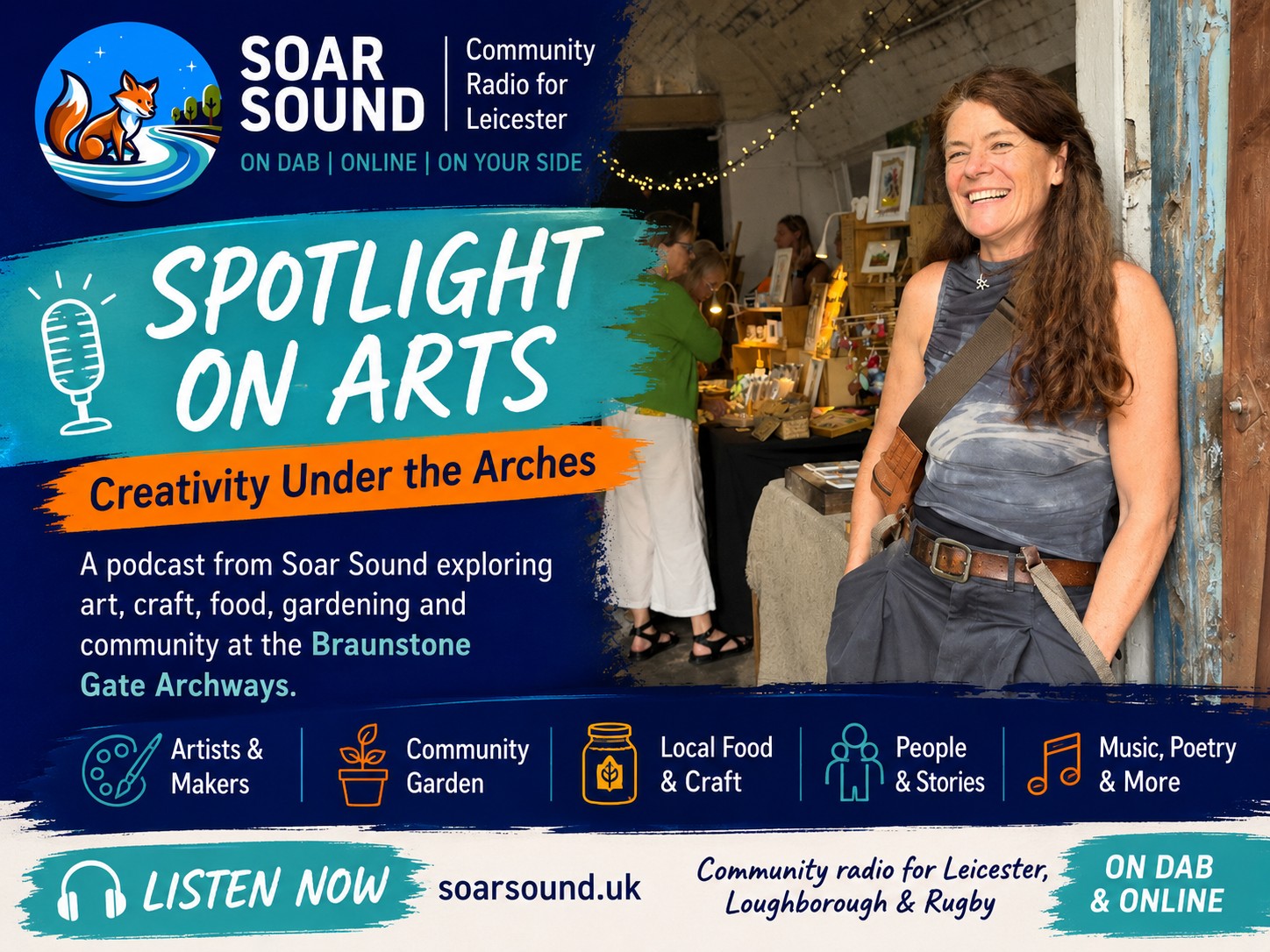
This edition of Spotlight on Arts visits the Braunstone Gate Archways, where a former industrial unit beside the Great Central Way has been transformed into a distinctive space for art, craft, food, gardening and community activity.
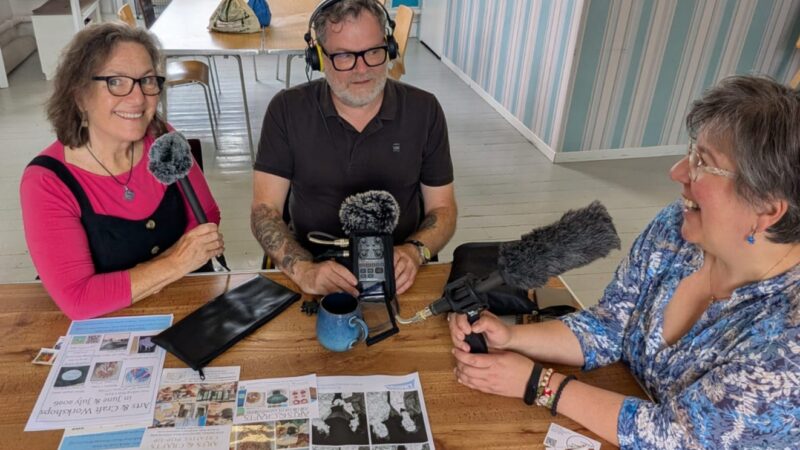
Recorded during an arts and crafts market organised by artist Traci Howard, the programme brings together the voices of artists, makers, volunteers and gardeners. Their experiences reveal how creative activity can give new purpose to neglected spaces while creating opportunities for conversation, experimentation and participation.
A Space With Its Own Character
The archway once formed part of the infrastructure connecting the railway, canal and surrounding industries. In more recent years, it was used as a mechanic’s workshop before being left damp, dusty and filled with discarded materials.
Traci first became involved while volunteering in the neighbouring community garden. Although the archway was in poor condition, she could see its potential.
After clearing the space, she began inviting local people to use it. An informal gathering was followed by a willow-weaving event, craft sessions, exhibitions and, eventually, the arts market featured in the programme.
The arch remains deliberately rustic. It has no conventional electricity supply or running water, but lighting, an inverter, a sink and other facilities have gradually been introduced. Rather than disguising its history, the space retains the texture and atmosphere of its previous uses.
For Traci, the archway is a kind of “giant canvas”: a place that can continue to change according to the ideas people bring to it.
Creativity as a Shared Experience
The market includes professional artists, independent makers, clothing designers and food producers. What connects them is not simply the opportunity to sell something. The event creates a setting in which people can explain their work, exchange ideas and meet others involved in Leicester’s creative community.
Tal, who has helped develop the site, describes it as both an event space and a testbed for off-grid living. Rainwater collection, solar energy, composting facilities and the neighbouring community garden demonstrate practical alternatives to conventional urban infrastructure.
The aim is not to withdraw from the city, but to become more conscious of where water, food and energy come from. In this sense, the archway is both a cultural venue and a small-scale experiment in self-sufficiency.
Making Time to Notice
Food writer and producer Matt Glover presents his Jars of Danger range, developed from recipes in his cookbook. He describes the idea behind the products as creating a “pause on a plate”.
That pause matters because independent food and craft can invite people to slow down and notice what they are experiencing. Rather than treating consumption as an automatic transaction, the market allows visitors to meet the person who created an object or prepared the food.
The value lies partly in the product, but also in the time, care and individual judgement invested in making it.
Resisting the Monoculture
Artists Stuart Heaking and Carl from Persecute discuss the difficulty of working independently in a culture dominated by multinational retailers and standardised fashion.
Carl argues that large corporations often produce a visual monoculture in which people are encouraged to look increasingly alike. Independent clothing and design provide an alternative: something distinctive that allows people to express their own tastes rather than simply adopting the imagery promoted by global brands.
Stuart’s prints draw on everyday objects, including cameras, sewing equipment and kitchen utensils. These objects are closely connected with his personal memories, but they also resonate with other people who recognise similar experiences.
The conversation raises an important question about artistic work. Artists may begin by making something intensely personal, but once that work enters a shared space, it can prompt recognition, memory and discussion among others.
Art, Identity and the Natural World
Artist Maya Stigner brings together graphic design, painting, citizen science and ecological research. Her work depicts bees, bumblebees and moths from Europe and the Indian subcontinent, reflecting her English and Indian heritage.
By telling the stories behind different species, Maya encourages people to think beyond familiar garden insects and recognise the global networks of pollination on which food, spices and ecosystems depend.
Her work demonstrates how art can communicate scientific and environmental ideas without reducing them to information alone. A painting becomes a point of entry into questions of identity, ecology, conservation and interdependence.
Creativity Creates Conversation
Cat, who makes polymer-clay earrings, explains how a craft activity at a friend’s hen celebration developed into a possible independent business.
For her, sincerity is central to creative practice. Making and selling objects is important, but the interaction with the person standing in front of the stall can be more meaningful than the transaction itself.
Craft markets offer an alternative to the isolation and self-consciousness that can be reinforced by social media. They bring makers and visitors into direct contact, creating opportunities to talk, respond and encounter different perspectives.
As Cat puts it, creativity creates conversation.
Growing Food in Limited Space
Next to the archway is a volunteer-led community garden managed as part of the wider effort to improve Braunstone Gate.
Lead gardener John Thompson explains how vegetables, flowers and plants are grown in containers and raised beds throughout the year. The garden also helps people understand that a conventional garden is not necessary to grow food.
Many nearby homes have small yards rather than gardens. By demonstrating container growing and offering plants that can be taken home, the project shows that windowsills, pots and modest outdoor spaces can still be productive.
The garden is therefore not only somewhere to grow food. It is a place where knowledge is exchanged and people can develop confidence through practical participation.
Bringing Forgotten Places Back Into Use
The Braunstone Gate Archways demonstrate what can happen when creative people are allowed to work incrementally, informally and with limited resources.
The project does not depend on turning the space into a polished cultural venue. Its value comes from its particular character, its affordability and its openness to different uses.
Exhibitions, workshops, markets, music, poetry, shared meals and gardening can all sit alongside one another. The space is shaped not by a single institutional programme, but by the people prepared to contribute time, ideas and practical labour.
This Spotlight on Arts programme captures a creative community in the process of making something together. It is a reminder that cultural activity does not always begin in established galleries or purpose-built venues. Sometimes it begins by clearing an abandoned archway, switching on a string of lights and inviting people inside.
Listen to the Podcast
Listen to the full podcast to hear from Tracy Howard, Tal, Matt Glover, Stuart Heaking, Carl from Persecute, Maya Stigner, Cat and John Thompson.
Find out more through Tracy Howard on Instagram at @tracy_howard, Braunstone Gate Archways on Facebook, Matt Glover at @mattgloverfood, Persecute at @persecute, Maya Stigner at @thisillusorylife, and Cat at @cat_scratch101.
Spotlight on Arts is produced for Soar Sound, broadcasting online and on DAB across Leicester, Loughborough and Rugby.