ReCreate – Giving Materials, Ideas and Communities a Second Life
Podcast: Play in new window | Download
What happens when something reaches the end of its expected life? For many materials, the answer is still straightforward. They are thrown away, stored indefinitely, or sent into waste systems where whatever creative potential they once contained disappears from view.
ReCreate, the new scrap store established by Kala Arts on Frog Island, starts from a different question. What might this material become next?
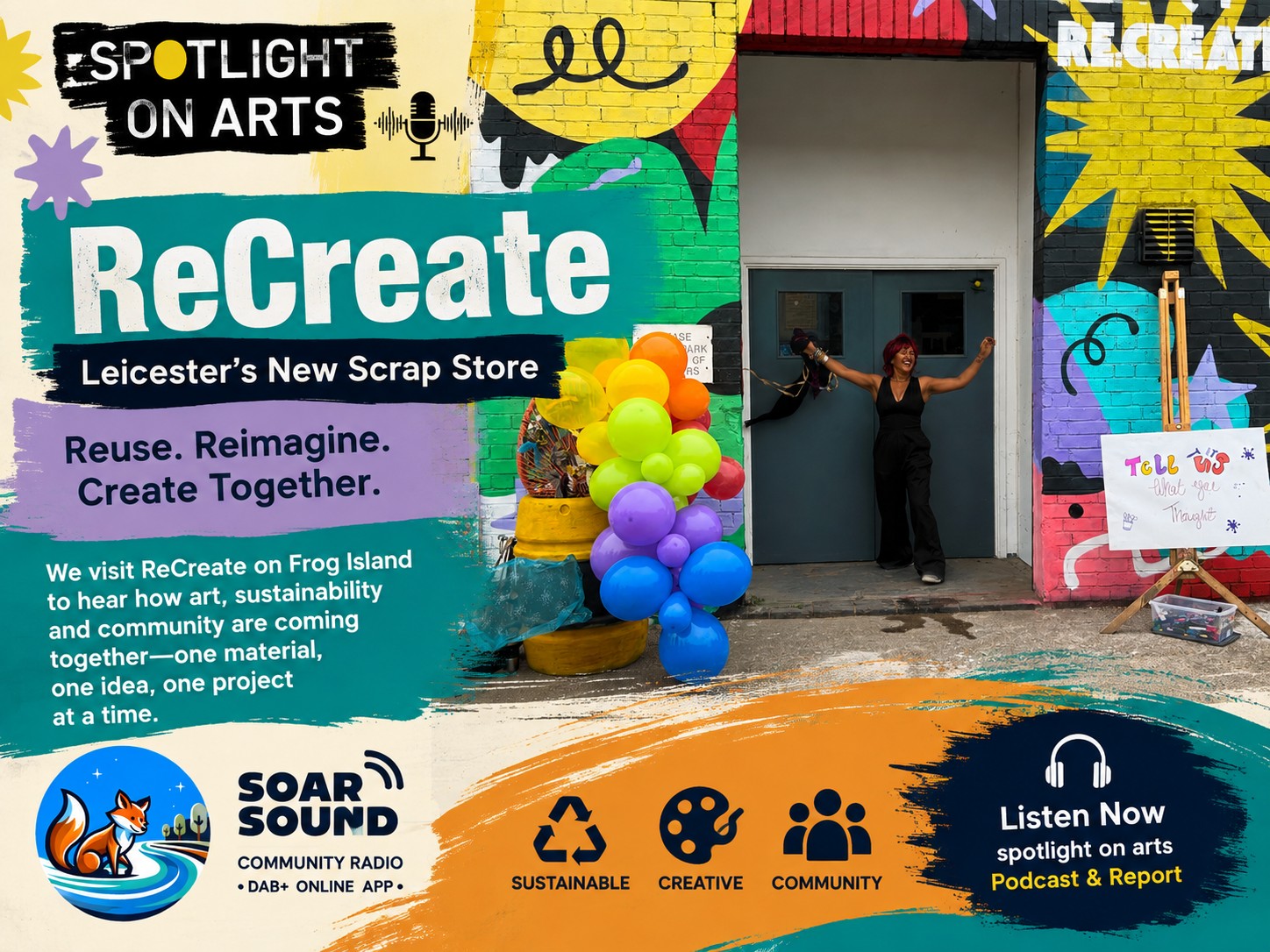
We visited ReCreate during its soft launch on 15th August, when artists, volunteers and visitors were beginning to explore the space and discover what a scrap store might offer.
The atmosphere was appropriately informal. Founder Sim welcomed people inside with a makeshift ribbon-cutting ceremony before visitors began looking through shelves, materials and workspaces. Nearby, artist and volunteer Daniel invited people to add pieces of discarded plastic to a collaborative mural.
It was a simple activity, but one that expressed much of the thinking behind the project. Plastic that might otherwise have entered landfill was being treated as creative material. Something apparently without value was being reconsidered through making.
ReCreate grew from Kala Arts’ own experience of trying to work sustainably.
Sim explains in the podcast that an earlier arts commission required a considerable amount of time simply to locate suitable materials. Connections were made with community members and scrap stores elsewhere in the country, but the experience exposed something missing locally: a place where reusable materials could be gathered, organised and made accessible to creative people.
The scrap store is therefore about more than inexpensive art supplies.
It represents a circular approach to creative practice. Manufacturing surplus, paper, card, craft materials and community donations can remain in circulation rather than automatically becoming waste. A box of old VHS tapes, for example, becomes interesting precisely because its future purpose has not yet been decided.
Its previous function does not have to determine what happens next.
That principle extends beyond materials.
Sim describes scrap stores elsewhere bringing together crafters, makers, hobbyists, students, nurseries, childminders and other people interested in making things. ReCreate hopes to create similar connections through workshops, swap events, sharing activities and opportunities for volunteering.
Volunteer Diane describes her involvement in equally practical terms: an interest in art, sustainability and working with other people. Asked whether volunteering requires a particular talent for sorting and organising, she suggests something more accommodating. People bring different strengths, learn as they participate and somehow make the organised chaos work.
There is something important in that description.
Creative spaces do not necessarily emerge because every element has been designed in advance. They can develop because people are given somewhere to contribute, experiment, learn from one another and gradually discover what the space can become.
The building itself reflects that process.
Kala Arts left its previous workshop space because a scrap store required something different: loading access, storage, room to organise materials and enough flexibility for people to move through the space easily.
The Frog Island premises began largely as an empty shell. Much of its development has followed the same resourceful principles as the scrap store itself, with materials, expertise and support gathered through relationships with other people and organisations.
At the same time, the building has deliberately been treated as an artwork rather than simply a warehouse. Its exterior and interior communicate that this is a place concerned with imagination as much as storage.
That distinction matters, because sustainability can sometimes be presented primarily as restriction: using less, consuming less or giving things up. ReCreate suggests another interpretation. Reuse can also enlarge the creative possibilities available to us.
An unwanted object can become the starting point for a sculpture. Manufacturing surplus can become workshop material. A discarded piece of plastic can become part of a communal artwork. An unused building can become a meeting place.
The value lies not simply in preventing something from being thrown away, but in changing how we look at what is already around us.
ReCreate is still at the beginning of that process. Its soft launch offered an opportunity for people to look around, ask questions and imagine how they might participate before the fuller launch planned for September.
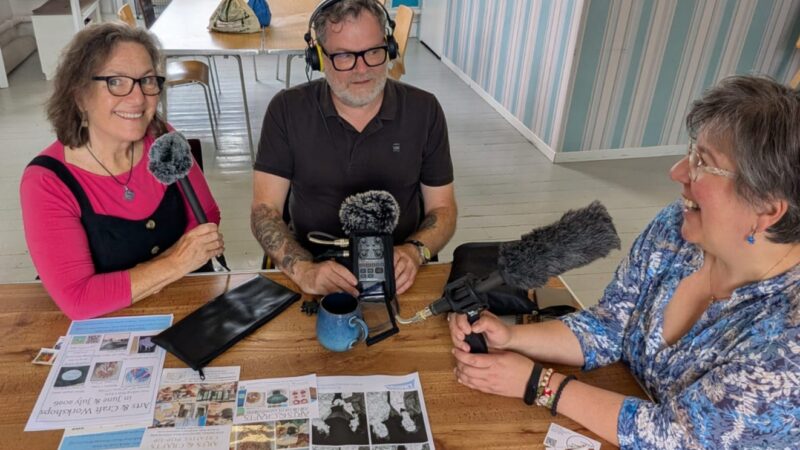
In this edition of Spotlight on Arts, we hear from Sim, Daniel and Diane about the origins of the project, the practical work involved in creating the scrap store, and the possibilities that emerge when creativity, sustainability and community participation begin to overlap.
Perhaps the most interesting question is also the simplest.
Before something is discarded, might we first ask what else it could become?